Last updated November 12, 2026. Next scheduled update: February 2027 earnings season (Spotify Q4 results) and the IFPI Global Music Report in March 2027.
About 837 million people used a paid music streaming subscription at the end of 2025, according to the IFPI Global Music Report 2026. Streaming brought in more than $22 billion that year, 69.6% of all recorded music revenue. Spotify is the largest service by a wide margin, with 788 million monthly users and 306 million paying subscribers as of September 30, 2026.
Most pages stop there. This one also tells you which of these numbers come from a company filing and which are analyst estimates, because the two get mixed up constantly.
How many people pay for music streaming?
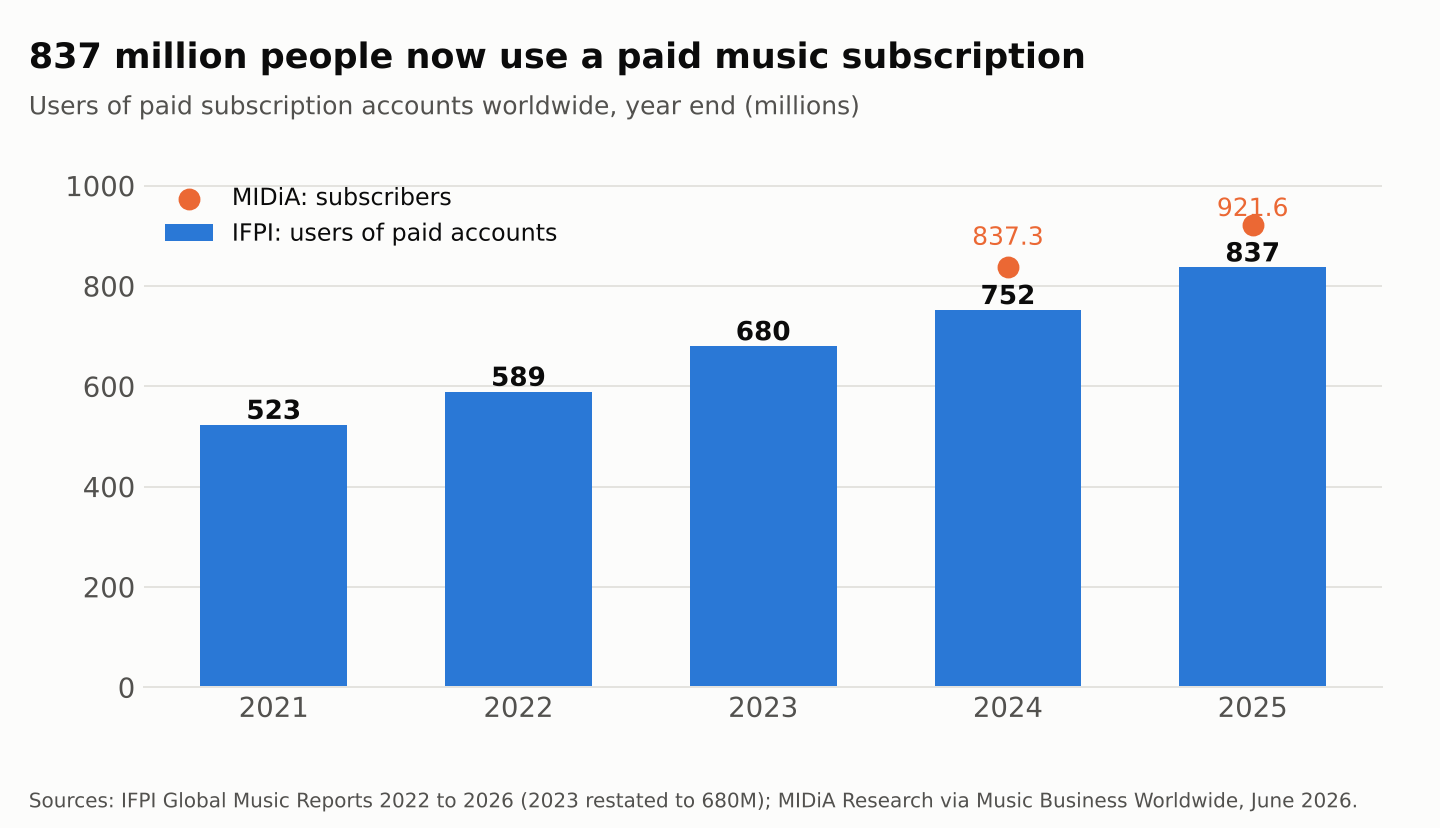
IFPI counts 837 million users of paid subscription accounts at the end of 2025. That's 85 million more than a year earlier and 60% more than in 2021.
| Year end | Users (millions) | Change |
|---|---|---|
| 2021 | 523 | |
| 2022 | 589 | +12.6% |
| 2023 | 680 (restated from 667) | +15.4% |
| 2024 | 752 | +10.6% |
| 2025 | 837 | +11.3% |
A caution on the early years: 2021 and 2022 use IFPI's earlier method, and 2023 onward is restated. On the old basis 2023 grew 13.2%, so treat the four-year growth as approximate.
Why you'll see both 837 million and 922 million
Two totals are in circulation, and they measure different things.
- IFPI: 837 million. This is the record industry's own count of people using a paid account. Since its 2025 report, IFPI's methodology has excluded people on paid trials (24.1 million of them in 2024).
- MIDiA Research: 921.6 million. This is an analyst firm's estimate of music subscribers, reported by Music Business Worldwide in June 2026. It grew 10.1% in 2025.
The gap is 84.6 million, about 10%. One detail makes it easy to remember: MIDiA's figure for the end of 2024 was 837.3 million, almost exactly what IFPI reported for the end of 2025.
Neither number is wrong. Use IFPI when you want the industry's own count. Use MIDiA when you need shares by platform, because IFPI doesn't publish those.
Music streaming revenue
Streaming generated more than $22 billion for record labels in 2025, 69.6% of global recorded music revenue. Paid subscriptions alone made up 52.4% of the total and grew 8.8%.
| Measure | 2025 |
|---|---|
| Total recorded music revenue | $31.7 billion (+6.4%) |
| Streaming revenue | More than $22 billion (69.6% of total) |
| Paid subscription streaming | 52.4% of total (+8.8%) |
| Physical formats | +8.0% |
| Vinyl | +13.7% (19th year of growth) |
| Consecutive years of growth | 11 |
These are wholesale figures: what labels receive, not what listeners pay. Spotify alone says it paid the music industry more than $11 billion in 2025, a total that includes publishers and songwriters as well as labels.
Music streaming market share
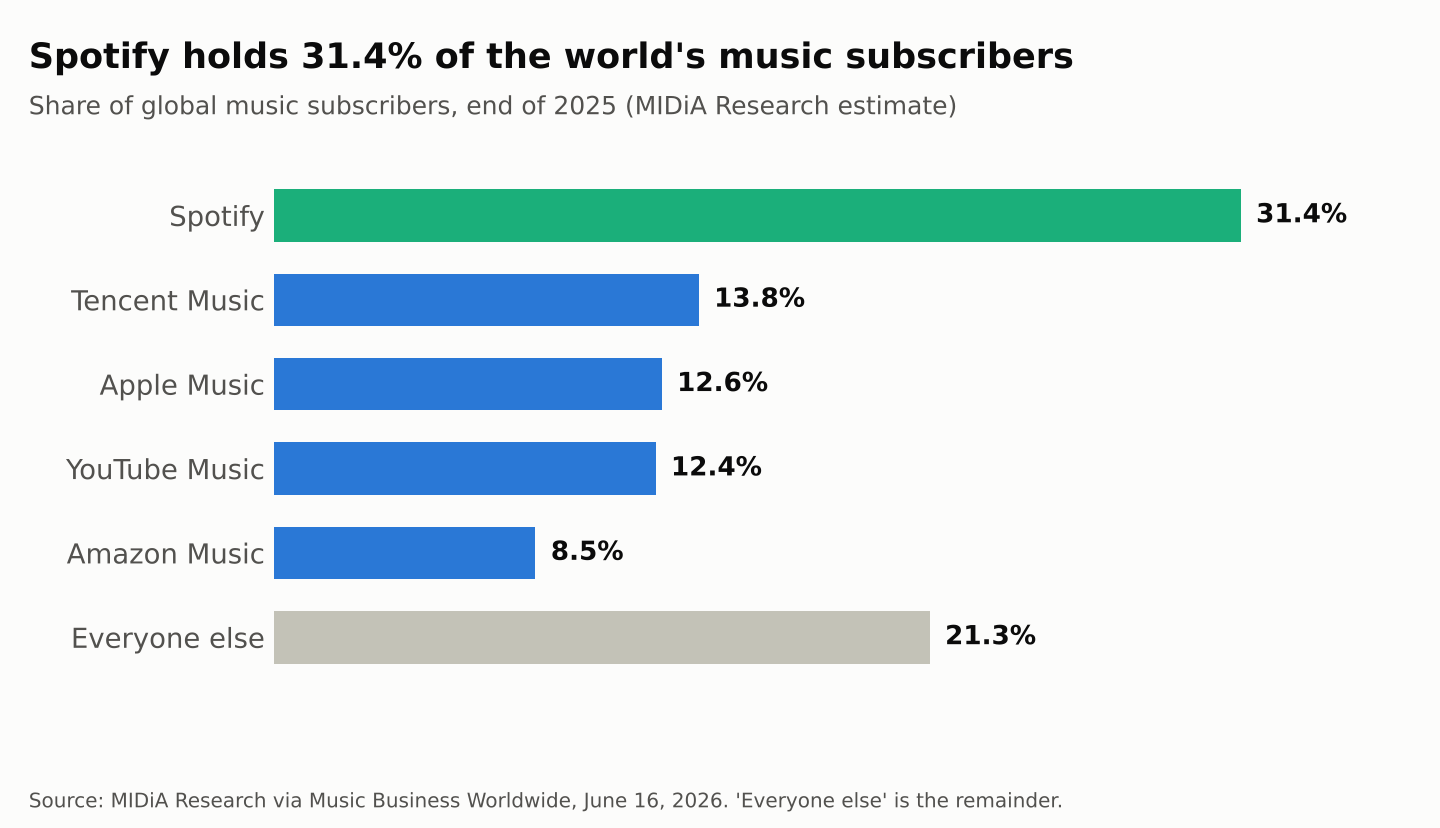
Spotify holds 31.4% of the world's music subscribers, more than Tencent Music and Apple Music combined. These shares are MIDiA Research estimates for the end of 2025, published in June 2026.
| Service | Share of subscribers | Implied subscribers |
|---|---|---|
| Spotify | 31.4% | About 289 million |
| Tencent Music | 13.8% | About 127 million |
| Apple Music | 12.6% | About 116 million |
| YouTube Music | 12.4% | About 114 million |
| Amazon Music | 8.5% | About 78 million |
| Everyone else | 21.3% | About 196 million |
Implied subscribers are our arithmetic: each share multiplied by MIDiA's 921.6 million total. Two of them can be checked. Spotify reported 290 million Premium subscribers for the same date, and Tencent Music reported 127.4 million paying users.
Three things stand out in the MIDiA data:
- YouTube Music is the fastest grower. Its share rose from 7.9% in 2020 to 12.4% in 2025. MIDiA expects it to pass both Apple Music and Tencent Music during 2026.
- Apple Music is losing share. It held 18.4% at the end of 2020 and 12.6% five years later.
- Growth has moved outside North America and Europe. Latin America, Asia Pacific and the rest of the world supplied more than 70% of new subscribers for the fifth year running.
Spotify gives a different kind of share for itself: it says it now accounts for roughly 30% of recorded music revenue.
Subscribers by platform: official vs estimated
Only Spotify, Deezer and Pandora publish a clean subscriber count every quarter. For every other service, what you read is a milestone with caveats, an old number or an estimate.
Spotify statistics
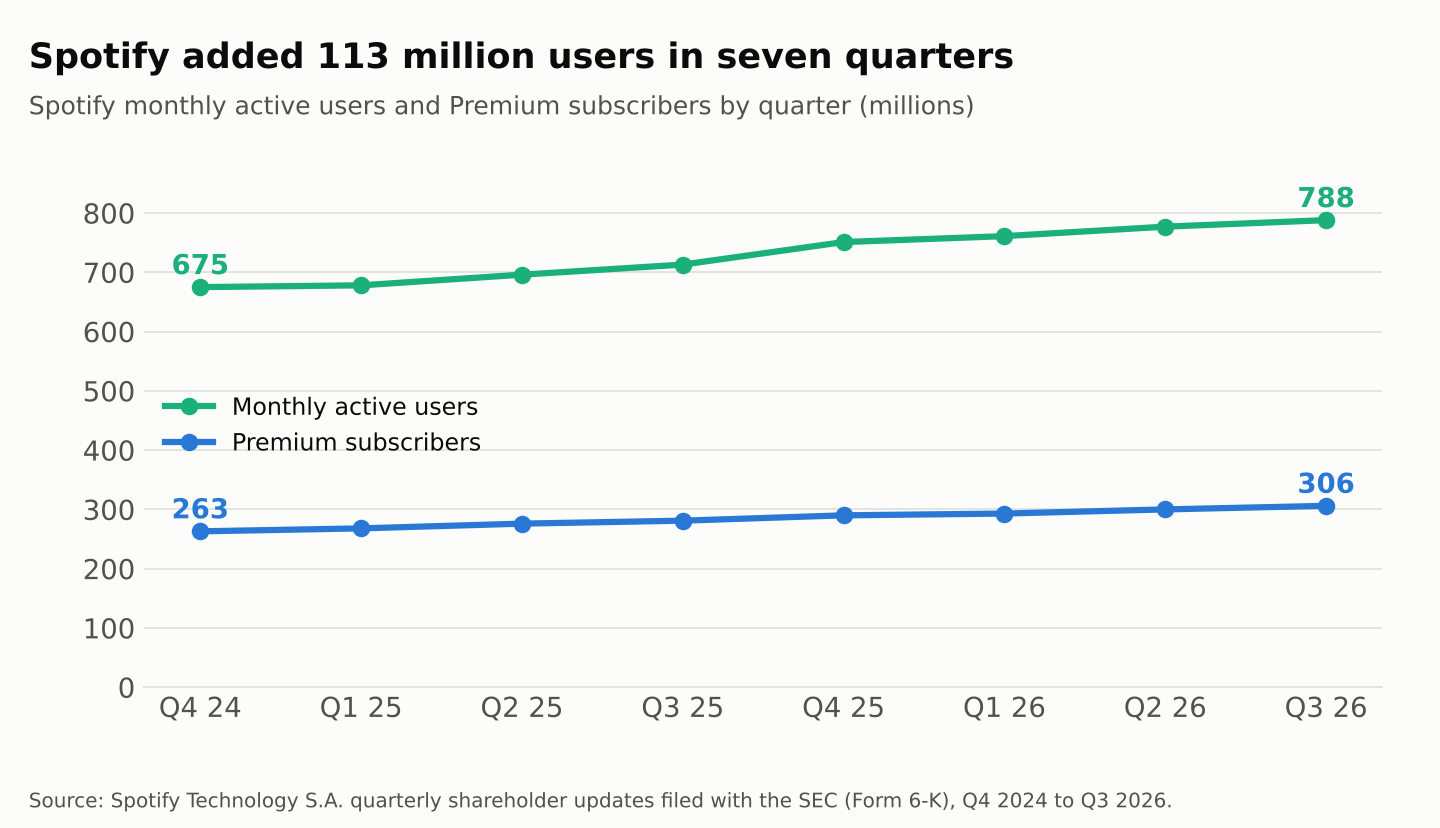
Spotify had 788 million monthly active users and 306 million Premium subscribers at the end of September 2026, according to its Q3 2026 shareholder update.
- Monthly active users: 788 million, up 11% in a year.
- Premium subscribers: 306 million, up 9%. It reached 300 million in Q2 2026.
- Ad-supported users: 499 million.
- Paying share: 39% of monthly users subscribe (our calculation).
- Quarterly revenue: €4.97 billion, of which Premium is €4.49 billion (90%).
- Markets: 184 countries and territories.
Spotify's free and paid counts overlap slightly, which is why 499 million and 306 million add up to more than 788 million.
| Quarter | Monthly active users | Premium subscribers |
|---|---|---|
| Q4 2024 | 675 | 263 |
| Q1 2025 | 678 | 268 |
| Q2 2025 | 696 | 276 |
| Q3 2025 | 713 | 281 |
| Q4 2025 | 751 | 290 |
| Q1 2026 | 761 | 293 |
| Q2 2026 | 777 | 300 |
| Q3 2026 | 788 | 306 |
If a page tells you Spotify has 713 million users, it's quoting Q3 2025. Want your own numbers instead of Spotify's? Our Spotify profile viewer shows your top artists and tracks.
YouTube Music subscribers
YouTube Music and YouTube Premium together passed 150 million subscribers, a milestone Alphabet disclosed with its Q3 2026 results on October 28, 2026. That number has two caveats most pages skip:
- It includes trials. Alphabet says so in the announcement.
- It isn't music only. YouTube Premium subscribers who never open YouTube Music are counted. Alphabet doesn't split the two.
| Date announced | Subscribers |
|---|---|
| September 2021 | 50 million |
| November 2022 | 80 million |
| February 2024 | 100 million |
| March 2025 | 125 million |
| October 2026 | 150 million+ |
For YouTube Music on its own, MIDiA's estimate works out to about 114 million subscribers at the end of 2025. MIDiA counts standalone YouTube Music plans plus the Premium subscribers who use the music app.
Apple Music statistics
Apple has not given an Apple Music subscriber count since June 2019, when Eddy Cue told French outlet Numerama it had passed 60 million. Reuters reported at the time that the figure included people on free trials.
- The "93 million in 2023" figure is not Apple's. It traces to a Statista estimate that many stats pages repeat as if it were official.
- Best current estimate: about 116 million, from MIDiA's 12.6% share of 921.6 million subscribers.
- Catalog: more than 100 million songs, a figure Apple has used since October 2022.
- US reach: 17% of Americans aged 12 and over used Apple Music in the past month (Edison Research, 2026).
Amazon Music subscribers
Amazon has never published an Amazon Music subscriber count. MIDiA's 8.5% share implies about 78 million subscribers at the end of 2025, which puts it fifth worldwide. In the US, 19% of people aged 12 and over used it in the past month, ahead of Apple Music.
Tencent Music subscribers
Tencent Music, which runs QQ Music, Kugou and Kuwo in China, reported 127.4 million paying users for Q4 2025. That's the last quarterly figure. The company said in the same release that it would stop disclosing monthly users, paying users and revenue per paying user each quarter, and will report total paying users once a year instead. Its 2026 results carry revenue only.
Deezer subscribers
Deezer had 8.7 million subscribers at the end of September 2026, down from 9.0 million a year earlier, according to its Q3 2026 results. Direct subscribers grew 5.7% to 5.8 million (3.9 million of them in France). Subscribers who come through telecom and retail bundles fell to 2.9 million.
Tidal subscribers
Tidal's owner, Block, does not publish a subscriber count. Figures you'll see quoted, usually between 3 and 10 million, are third-party estimates with no filing behind them. We don't repeat one here.
Pandora users
Pandora had 38.8 million monthly active users and 5.5 million paying subscribers at the end of September 2026, per SiriusXM's Q3 2026 filing. Monthly users fell 7% in a year. Pandora operates in the US only.
Reach, Payers, Payouts: how to read any streaming stat
Almost every confusing comparison in this field mixes up three different counts. Before you quote a number, work out which one it is.
- Reach is everyone who uses a service, paying or not. Spotify's 788 million and Pandora's 38.8 million are reach numbers.
- Payers are people or accounts with a paid plan. Check three things: are trials included, is a family plan one account or up to six users, and is a bundled product counted?
- Payouts are dollars. Check whether it's what listeners paid, what the service earned or what labels received. Those can differ by a factor of two or three.
| Figure | Type | What's inside it |
|---|---|---|
| Spotify 788 million | Reach | Free and paid users active in the last 30 days |
| Spotify 306 million | Payers | Each family or Duo member counts as a subscriber |
| YouTube 150 million | Payers | Trials and all YouTube Premium members included |
| IFPI 837 million | Payers | Users of paid accounts, trials excluded |
| RIAA 111.1 million (US) | Payers | Accounts: one family plan counts once |
| IFPI $22 billion | Payouts | Wholesale revenue to labels, no publishing |
| Spotify $11 billion | Payouts | Paid to labels, distributors and publishers |
This is why "Spotify has 306 million subscribers and the US has 111 million accounts" can't be divided into each other. One counts people, the other counts bills.
What one subscriber is worth
A paying music subscriber is worth anywhere from $1.65 to $7.86 a month depending on where they live and whose books you read. We worked this out from each company's latest filing. No other stats page publishes this comparison.
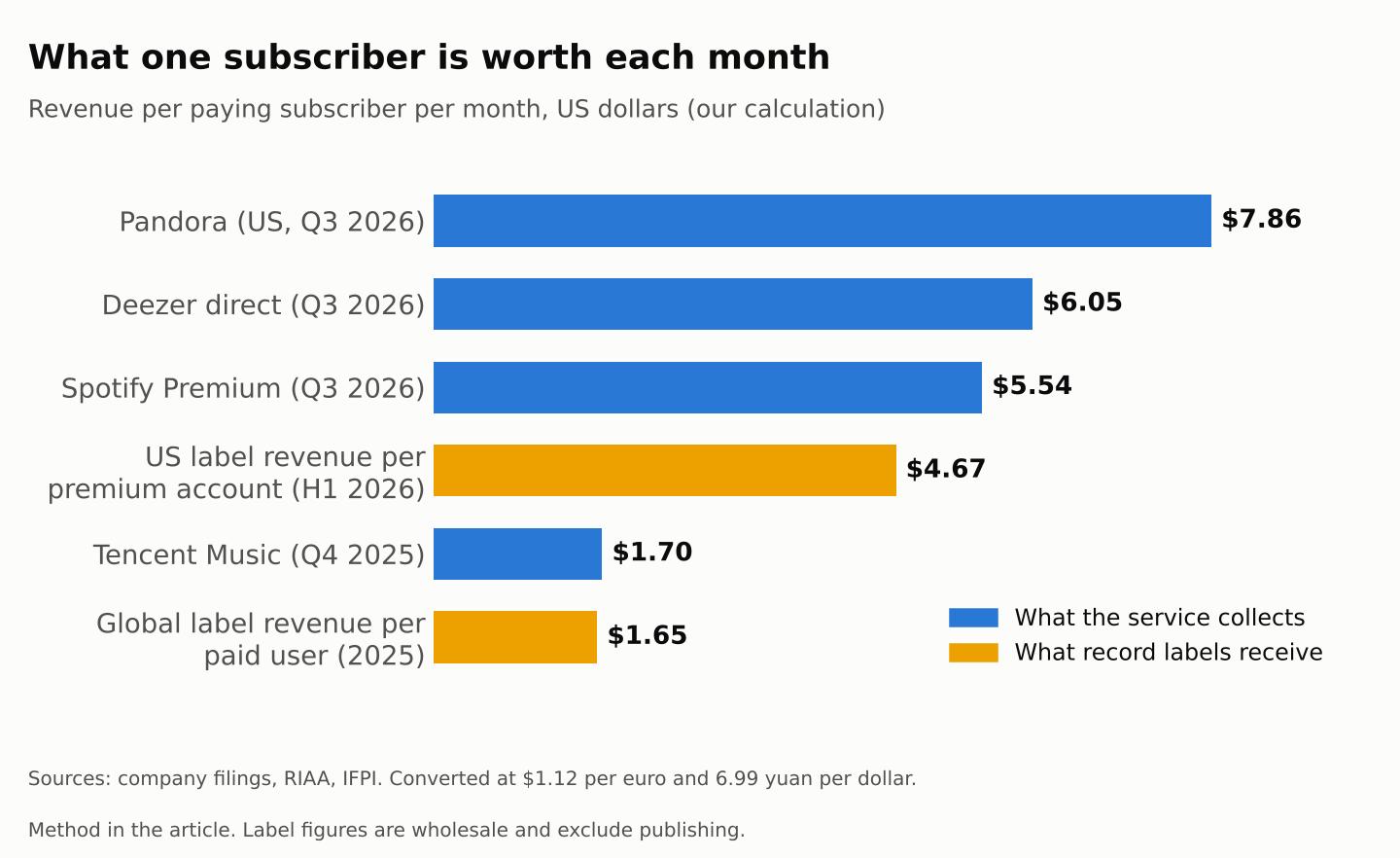
| Service or market | Per month | How we got it |
|---|---|---|
| Pandora (US) | $7.86 | $130 million Q3 subscription revenue, 5.514 million subscribers |
| Deezer, direct | €5.40 ($6.05) | Reported by Deezer for Q3 2026 |
| Spotify Premium | €4.95 ($5.54) | Reported by Spotify for Q3 2026 (our own division gives €4.94) |
| US labels, per premium account | $4.67 | $3,112.6 million H1 2026 premium revenue, 111.1 million accounts |
| Tencent Music | RMB 11.9 ($1.70) | Reported by Tencent Music for Q4 2025 |
| World labels, per paid user | $1.65 | 52.4% of $31.7 billion, 837 million users |
Read this table carefully. The first three rows and Tencent are what the service collects. The two "labels" rows are what record companies receive after the service takes its cut, and they exclude songwriter royalties.
The useful comparison is Spotify against its own price list. A US individual plan costs $12.99, yet the average Spotify subscriber worldwide brings in about $5.54. Family plans, student discounts and lower prices in India, Latin America and Southeast Asia account for the difference. Our music streaming price history tracks the list prices.
How much do streaming services pay per stream?
No service pays a fixed rate per stream. Each one pools its revenue and divides it by share of total listening, so the "rate" is only an average you can calculate afterwards. The best measured averages come from Duetti, a catalog investor that analysed real royalty statements from independent artists.
| Service | Per 1,000 streams | Per stream | Streams to earn $1,000 |
|---|---|---|---|
| Amazon Music | $8.80 | $0.0088 | About 114,000 |
| Tidal | $6.80 | $0.0068 | About 147,000 |
| Apple Music | $6.20 | $0.0062 | About 161,000 |
| YouTube | $4.80 | $0.0048 | About 208,000 |
| Spotify | $3.00 | $0.0030 | About 333,000 |
| All services, blended | $3.41 | $0.0034 | About 293,000 |
Figures are as reported by Digital Music News and Headphonesty, which both covered the report. They cover 2024 and the recording side only. The blended average fell from $4.04 in 2021 to $3.41 in 2024.
How much does Spotify pay per stream?
About $0.003 on average for the recording, or $3 per 1,000 streams, on Duetti's 2024 data. Spotify pays less per stream than rivals for a structural reason: 499 million of its 788 million users are on the free tier, and free streams earn far less than paid ones.
Low per stream doesn't mean low in total. Spotify's Loud & Clear report gives these figures for 2025:
- More than $11 billion paid to the music industry, and nearly $70 billion since launch.
- Roughly half of royalties went to independent artists and labels.
- More than 13,800 artists generated at least $100,000 from Spotify alone.
- More than 1,500 artists generated over $1 million.
One rule matters for small artists: since 2024, a track needs at least 1,000 streams in the previous 12 months before it earns recording royalties on Spotify.
A sanity check from the top down
Divide IFPI's streaming revenue ($22.06 billion) by Luminate's 5.1 trillion audio streams for 2025 and you get roughly $0.0043 per stream to labels worldwide. That's our estimate and it runs slightly high, because IFPI's revenue includes video streaming and Luminate's stream count doesn't. It still lands between Duetti's Spotify and YouTube figures, which is what you'd expect.
How many songs are on streaming services?
There were 253 million tracks on audio streaming services at the end of 2025, according to Luminate's 2025 Year-End Music Report. That's 37.9 million more than a year earlier.
How many songs are on Spotify?
Around 250 million. Spotify's marketing still says "over 100 million tracks", but co-CEO Gustav Söderström said on the Q1 2026 earnings call that the catalog is now "something like 250 million tracks", up from about 2 million when he joined in 2008.
How many songs are uploaded every day?
- 2024: 99,000 new tracks a day (Luminate).
- 2025: 106,000 a day, up 7% (Luminate).
- 2026: close to 150,000 a day, according to Luminate CEO Rob Jonas speaking on Billboard's On the Record podcast in September 2026.
At 150,000 a day, that's about 104 tracks every minute and nearly 55 million a year.
Most tracks are barely played
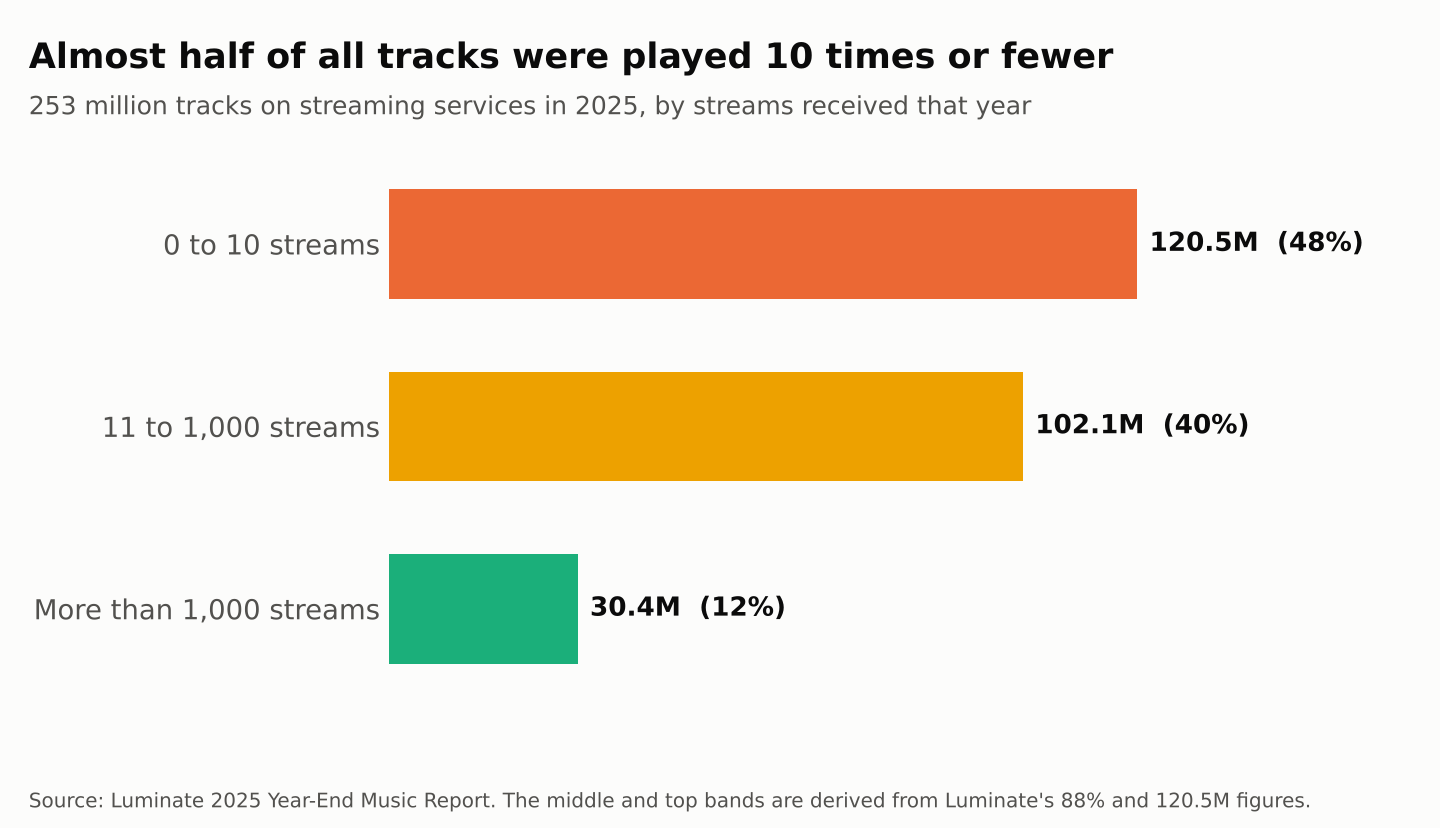
- 88% of tracks received 1,000 streams or fewer in 2025.
- 120.5 million tracks (48%) received 10 streams or fewer.
- 29 tracks passed 1 billion streams in the year.
AI music statistics
More than half of the tracks delivered to Deezer each day are now fully AI-generated, but they account for only 1% to 3% of listening. Deezer is the one service that publishes these numbers.
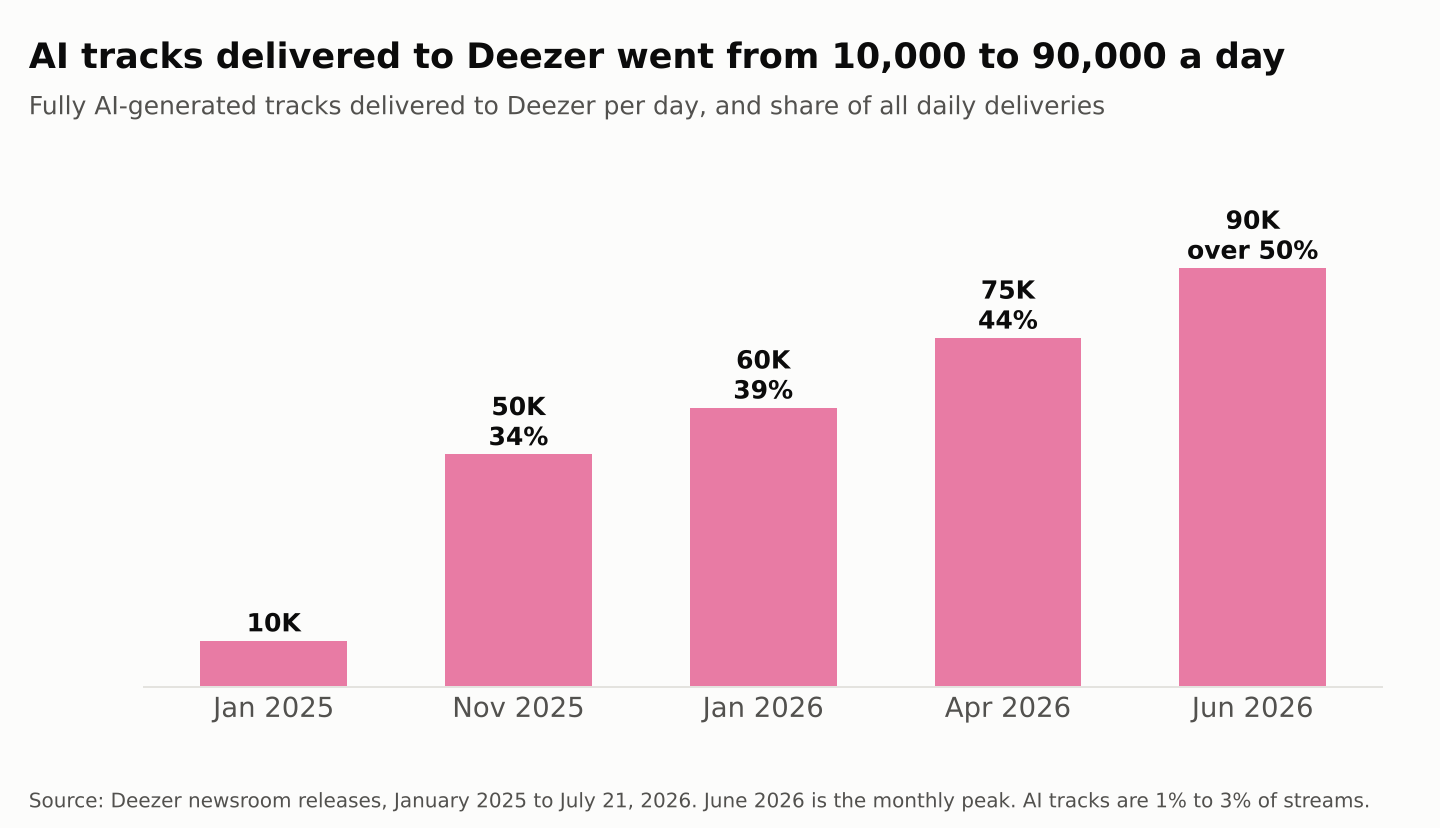
- About 90,000 fully AI-generated tracks a day reached Deezer in June 2026, more than 50% of daily deliveries.
- 10,000 a day was the figure when Deezer switched on its detection tool in January 2025.
- 1% to 3% of streams on Deezer go to AI tracks, and up to 85% of those streams were flagged as fraudulent in 2025 and not paid.
- 75 million "spammy" tracks were removed by Spotify in the 12 months to September 2025.
The supply of music has changed far more than the demand for it. That's the single most important thing to understand about AI and streaming right now.
US music streaming statistics
The US had 111.1 million premium paid subscription accounts in the first half of 2026, and streaming made up 82% of recorded music revenue, according to the RIAA's 2026 mid-year report.
| Measure | First half of 2026 | Full year 2025 |
|---|---|---|
| Total revenue | $5.97 billion (+6.9%) | $11.5 billion (+3.1%) |
| Streaming revenue | $4.9 billion (+4.7%) | $9.5 billion |
| Streaming share of total | 82% | 82% |
| Premium paid accounts | 111.1 million (+5.5%) | 106.5 million |
| Premium subscription revenue | $3.11 billion (+7.8%) | $5.88 billion (+6.8%) |
| Free (ad-supported) streaming | $900 million (+3.7%) | $1.79 billion |
Two notes on older figures you may find:
- "Streaming is 84% of US revenue" is out of date. The RIAA switched from retail to wholesale reporting in 2025. On the new basis the share is 82%, and has been for five years.
- The US is a third of the world's subscription money. The RIAA's 2025 year-end announcement says the US makes up one third of global paid subscription value.
Most popular music streaming services in the US
Spotify is the most used service in the US, with YouTube Music close behind, according to Infinite Dial 2026 from Edison Research at SSRS, a January 2026 survey of 2,050 Americans aged 12 and over.
| Service | Used in the past month | Used most often |
|---|---|---|
| Spotify | 36% | 32% |
| YouTube Music | 34% | 23% |
| Pandora | 21% | 12% |
| Amazon Music | 19% | Not reported |
| Apple Music | 17% | 12% |
| iHeartRadio | 12% | Not reported |
"Used in the past month" is a share of all Americans 12 and over. The brand figures are as summarised by PPC Land. Among 12 to 34 year olds, 49% name Spotify as their main service. In total, 81% of Americans (233 million people) listened to online audio in the past month.
US stream counts
Americans played 732.7 billion on-demand audio streams in the first half of 2026, up 4.8%, according to Luminate's 2026 Midyear Report. That's 26% of the world's streams from about 4% of its population.
Streaming by region
Streaming is growing more than twice as fast outside the US as inside it. In the first half of 2026, streams outside the US rose 11.8% to 2.0 trillion while US streams rose 4.8% (Luminate).
| Region | Growth | Note |
|---|---|---|
| Latin America | +17.1% | Streaming is 88.1% of revenue |
| Middle East and North Africa | +15.2% | Streaming is 97.5% of revenue |
| Sub-Saharan Africa | +15.2% | $120 million market |
| Asia | +10.9% | China +20.1%, Japan +8.9% |
| Europe | +5.6% | 30.4% of global revenue |
| USA and Canada | +3.5% | 38.7% of global revenue |
| Australasia | +1.5% | $623 million market |
The ten largest recorded music markets in 2025, per IFPI, were the USA, Japan, the UK, China, Germany, France, South Korea, Brazil, Canada and Mexico. China passed Germany for fourth place, and Mexico entered the top ten.
Streaming records
The most-streamed song on Spotify is "Blinding Lights" by The Weeknd, with 5.68 billion streams as of November 12, 2026, according to Kworb's daily tracker. The most-streamed artist by lead credits is Taylor Swift, at about 129 billion streams (about 133 billion including features), per Kworb's artist totals. Count features and Drake's total is higher, at about 144 billion.
- Spotify's own all-time list from April 2026 ranks Taylor Swift, Bad Bunny and Drake as its top three artists.
- The most-streamed album is Bad Bunny's Un Verano Sin Ti.
- Bad Bunny was Spotify's top artist of 2025, his fourth time at number one.
We keep the full, regularly updated ranking on our most-streamed songs and artists on Spotify page.
FAQ
How many people use music streaming services?
IFPI counts 837 million users of paid subscription accounts at the end of 2025. Including free listeners the number is far higher: Spotify alone has 788 million monthly users, 499 million of them on its free tier.
What is the biggest music streaming service?
Spotify, on every measure. It has 306 million paying subscribers and a 31.4% share of global music subscribers. Tencent Music is second by subscribers at 13.8%.
How many subscribers does Spotify have?
306 million Premium subscribers as of September 30, 2026, up 9% in a year. Its total monthly audience is 788 million.
How many subscribers does YouTube Music have?
Alphabet reports more than 150 million subscribers across YouTube Music and YouTube Premium combined, including trials, as of October 2026. It doesn't give a figure for YouTube Music alone. MIDiA's estimate is about 114 million for the end of 2025.
How many people use Apple Music?
Apple doesn't say. Its last stated figure was over 60 million in June 2019. MIDiA Research estimates about 116 million subscribers at the end of 2025.
Is Apple Music bigger than Spotify?
No. Spotify has roughly two and a half times as many subscribers worldwide. In the US, 36% of people aged 12 and over used Spotify in the past month, against 17% for Apple Music.
What percentage of music revenue comes from streaming?
69.6% worldwide in 2025 (IFPI) and 82% in the US in the first half of 2026 (RIAA).
How many streams does it take to make $1,000?
About 333,000 on Spotify, 161,000 on Apple Music and 114,000 on Amazon Music, using Duetti's 2024 averages for independent recordings. A label or distributor may take a share of that.
How many songs are uploaded to Spotify every day?
Spotify doesn't publish a daily figure. Across all streaming services, Luminate counted 106,000 new tracks a day in 2025 and its CEO put the 2026 pace at close to 150,000.
How much music is streamed each year?
5.1 trillion on-demand audio streams in 2025, up 9.6%. The first half of 2026 added another 2.8 trillion.
Methodology and sources
Every figure on this page comes from a company filing, a trade body report or a named research firm, and each is linked where it first appears. Where a number is our own arithmetic, the text says so and the inputs are in the table next to it.
- Primary sources used: IFPI Global Music Report 2026; RIAA 2025 year-end and 2026 mid-year revenue reports; Luminate 2025 Year-End and 2026 Midyear reports; SEC filings from Spotify and SiriusXM; investor releases from Tencent Music, Deezer and Alphabet; Spotify Loud & Clear 2026; Deezer newsroom; Edison Research Infinite Dial 2026.
- Estimates used, and labelled as such: MIDiA Research subscriber shares (via Music Business Worldwide); Duetti per-stream averages (via trade press).
- Implied subscriber counts: MIDiA share multiplied by its 921.6 million total, rounded to the nearest million.
- Revenue per subscriber: quarterly subscription revenue divided by subscribers, divided by three months. Spotify, Deezer and Tencent Music figures are the companies' own reported averages. Pandora is our division, using closing subscribers. Currency converted at $1.12 per euro and 6.9931 yuan per dollar, the rate stated in Tencent Music's Q4 2025 release.
- Revenue per stream: 69.6% of $31.7 billion divided by 5.1 trillion streams.
- What we left out: subscriber figures for Tidal and Amazon Music with no filing behind them, market size forecasts from report vendors, and any statistic we couldn't trace to its origin.
The dataset behind the charts is available as a CSV file. Spotted an error or a newer figure? Tell us and we'll correct it.