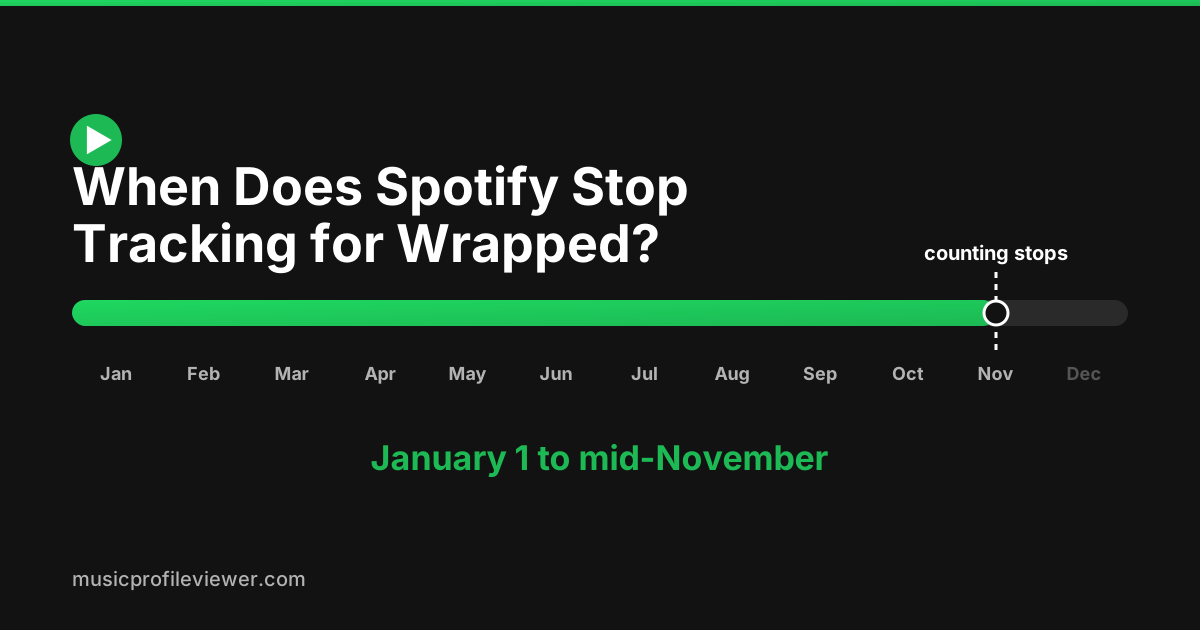
Spotify Wrapped counts your listening from January 1 through roughly the middle of November. It does not track the full calendar year. For Wrapped 2025, Spotify confirmed the window ran from January until mid November, a few weeks before the December 3 launch. So your streams from mid November onward, and all of December, do not count toward this year's Wrapped.
That is the quick version. The longer version is more interesting, because Spotify has been slippery about the exact date for years, an old "October 31" rumor refuses to die, and people genuinely argue about it every fall. Here is what is confirmed, what is guesswork, and why your favorite December song is never going to show up.
The short answer: January 1 to about mid-November
Two things anchor the tracking window, and only one of them has ever been in real doubt.
The start is simple. Spotify begins counting on January 1. Molly Holder, Spotify's senior director of product for personalization, put it plainly: "We start at the beginning of January. It goes all the way through collecting data up until a few weeks before we launch the Wrapped product." So there is no mystery about the front end. Every play from New Year's Day forward is fair game.
The end is where it gets fuzzy. Spotify stops counting a few weeks before Wrapped goes live so its team has time to crunch the numbers, build everyone's personalized story, and ship it. In practice that has meant a cutoff somewhere in early to mid November. For the most recent Wrapped, Spotify finally gave a real number, which we will get to in a second.
If you want the bigger picture on when the whole thing actually drops, we cover that in when does Spotify Wrapped come out.
What Spotify actually confirmed for Wrapped 2025
For years Spotify refused to name a cutoff date. That changed with Wrapped 2025. In a Spotify Newsroom post published the day Wrapped launched, the company spelled it out: "Wrapped captures your 2025 listening journey from January until mid November, just a few weeks prior to this year's launch on December 3."
That is about as official as it gets. Wrapped 2025 counted roughly ten and a half months of listening, from New Year's Day through the middle of November 2025. The gap between the cutoff and the December 3 release is the window Spotify uses to actually build the thing.
This matters because it settles a debate that had raged for years. The cutoff is not October 31. It is later than that, closer to mid November, and Spotify itself now says so.
The October 31 myth that will not die
If you have seen a post claiming Spotify "stops counting on Halloween," you are looking at a zombie rumor. Here is where it came from and why it is wrong.
Years ago, outlets including Billboard and Newsweek reported that Wrapped only counted activity between January 1 and October 31. A Spotify representative even told Newsweek back in 2021 that the October cutoff existed for "logistical" reasons, because "time is needed for quality assurance and other preparation." So the idea had some basis at one point.
Then Spotify moved the goalposts, or at least clarified them. In October 2023, the company posted on its social accounts that "Wrapped is still counting past Oct. 31." The following year it got even blunter. Ahead of Halloween 2024, as users joked they had 24 hours left to fix their stats, Spotify posted a Halloween-themed graphic that said flatly: "Spotify Wrapped doesn't stop counting on October 31st."
So the modern, verified position is clear. October 31 is not the cutoff. Anyone telling you to cram all your favorite songs in before Halloween is working off outdated information. You have until roughly mid November.
Does Spotify Wrapped count December?
No. This is the part that stings.
If the tracking window ends in mid November, then late November and the entire month of December are not counted. Your holiday playlist marathon, that one album you discover on December 20 and play forty times, the song that becomes your whole personality over the break, none of it lands on this year's Wrapped. It rolls into next year's instead, assuming you are still playing it in January.
There is a small irony here. Wrapped is a December event, but December listening never counts toward the Wrapped you are looking at. It is a snapshot that was already sealed weeks before it reached your phone. If you are the type who goes deep on Christmas music or year-end releases, your Wrapped will quietly ignore all of it.
The practical takeaway: if a song matters to you and you want it on your Wrapped, the plays need to happen before mid November. After that, you are building next year's list.
Does listening on desktop or the web count?
Yes. All of it counts, no matter what device you used.
Wrapped is tied to your Spotify account, not to a single phone or app. Whether you stream on the desktop app, the web player at open.spotify.com, a smart speaker, a game console, a car display, or your phone, every play flows to the same account and feeds the same year-end tally. There is no penalty for listening on a laptop and no bonus for listening on mobile.
The confusion usually comes from a different fact. The full, animated Wrapped story, the swipeable slideshow you share to Instagram, is built for the phone app first. A web recap at spotify.com/wrapped usually shows up during the season, but the polished experience wants your phone. That is about where you view Wrapped, not about what counts toward it. Your desktop listening was counted all along. For more on the whole experience and its sections, see what is Spotify Wrapped.
What actually gets counted (and what gets filtered out)
A few finer points from Spotify's own explanation of how Wrapped is built.
Wrapped counts pretty much all of your real listening, including plays from private sessions (incognito mode) and even tracks you have set to "exclude from taste profile." Those still show up in your minutes and your top songs, they just do not steer your recommendations.
What Spotify strips out is ambient noise. Things like white noise, rain sounds, and sleep tracks get filtered so that Wrapped reflects music and podcasts you actually chose to play, not the eight hours of thunderstorm audio you ran overnight. That keeps a sleep soundscape from accidentally becoming your "top artist," which used to happen to people.
Why people still argue about the exact date
Even with Spotify now saying "mid November," the precise day is not published, and that drives people a little nuts every autumn. Head into the Spotify Community forums and you will find the same question posted year after year. One user asked whether songs played in November count, saying they had heard conflicting cutoffs of October 31 and November 15. A Spotify Community expert replied honestly: "Unfortunately, there's no official word on when the cutoff date is." You can read that exchange in the Spotify Community thread on November listening, and there is a longer running one titled Spotify Wrapped stops tracking plays during November. The debate runs just as hot on r/truespotify and r/spotify each fall, where the "October 31 versus mid-November" argument comes back every single year.
The reason the debate never resolves is that Spotify leaves itself wiggle room on purpose. "A few weeks before launch" and "mid November" are ranges, not a stamped date, and the launch date itself shifts by a few days each year. So the safe mental model is this: assume the counting stops around the second week of November, treat anything after that as a bonus that probably will not count, and do not trust anyone who quotes you an exact hour.
What about average Wrapped minutes?
People love comparing their minutes, so it comes up a lot: what is a normal number? There is no official global average that Spotify publishes. One widely shared estimate pegged the typical listener at roughly 3,700 minutes a year, about 61 hours, but that figure was extrapolated from Wrapped data rather than confirmed by Spotify, and heavy listeners blow past it easily. Plenty of people clear 40,000 or even 80,000 minutes. The honest answer is that "average" is nearly meaningless here, because listening habits are wildly spread out.
The number that actually matters is your own, and you do not have to wait until December to see where you stand.
See your stats any time, not just in December
The frustrating thing about Wrapped is that it is a once-a-year, already-sealed snapshot. It ignores December, it locks in weeks before you see it, and there is no button to check your current standing in, say, March.
That is the gap Music Profile Viewer fills. It is a free Spotify stats viewer that logs in with your official Spotify account, read only, and shows your top artists, top tracks, and recently played across different time ranges (last four weeks, last six months, and all time).
It will not recreate the exact animated Wrapped slideshow, and it cannot show anyone else's private stats, but it gives you the same kind of "here is what I have been playing" picture on demand. So if you want to know who is actually winning your year in July, or you want to see whether that December obsession is holding up, you can just look.
If checking your listening whenever you feel like it sounds better than waiting for one December drop, that is the whole idea behind seeing Wrapped-style stats anytime.
Sources and further reading
- Spotify Newsroom - The Simple Truth About How Your Wrapped Comes to Life
- Official Charts - When does Spotify Wrapped come out and how to see it
- AOL - When does Spotify Wrapped stop tracking for 2024? Streamer dismisses false rumor
- AOL - Spotify Wrapped 2025: When does it stop tracking your listening?
- Wikipedia - Spotify Wrapped
- Spotify Community - Does Spotify Wrapped count songs I listen to in November?
- Reddit - r/truespotify
- Reddit - r/spotify
- Dataconomy - What is the average Spotify listening time?