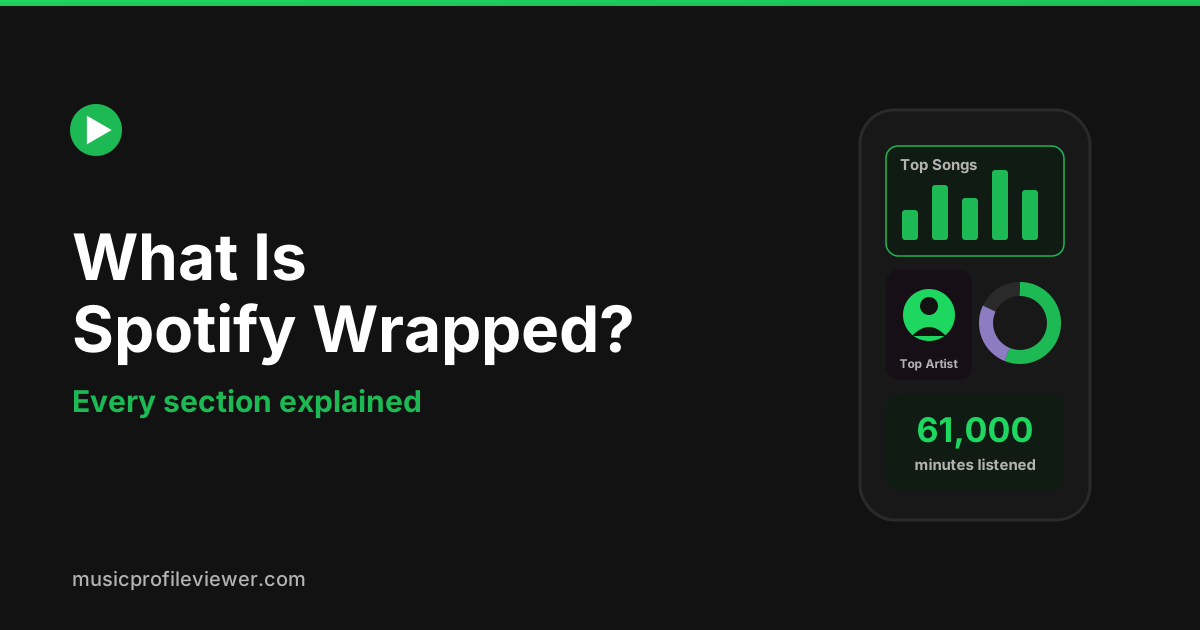
Once a year, usually in the first week of December, your Spotify app turns into a colorful, tappable recap of everything you played over the past twelve months. It counts your minutes, ranks your favorite songs and artists, names the genres you leaned on, and packages it all as bright, shareable cards that flood everyone's Instagram Stories on the same day. That yearly recap is Spotify Wrapped, and it has grown from a simple stats page in 2016 into a sprawling, gamified experience with quizzes, AI reports, and even a multiplayer mode.
If you have ever wondered what all those screens actually mean, or why half your feed suddenly turns into pastel gradients every December, this guide walks through how Wrapped works and breaks down every section, using the 2025 edition (released December 3, 2025) as the reference point.
How does Spotify Wrapped work?
At a high level, Wrapped is a summary of the listening Spotify already tracks on your account all year. Every time you play a song, podcast, or audiobook, that activity is logged against your profile. Once a year Spotify takes roughly the last twelve months of that data, runs it through its personalization systems, and turns the numbers into a story format, those swipeable cards you see in the app.
One detail that surprises people: Wrapped does not count the full calendar year. Spotify stops tallying data at a cutoff, historically somewhere around late October or early November, then spends the following weeks building everyone's recap before the December launch. So a song you binged in mid November might not make the cut. We cover the exact timing in when does Spotify Wrapped stop tracking, and the release date pattern in when does Spotify Wrapped come out.
Wrapped is built mobile-app-first. The full interactive slideshow is designed for the phone app, and you usually need the latest app version for the Wrapped hub to appear. A web recap at spotify.com/wrapped tends to show up during the season with a lighter version of the data, but the shareable story really wants your phone. It is also free for everyone. You do not need Premium to get a Wrapped, though a few extras have historically been Premium-only. If yours is not appearing, our guide on how to see your Spotify Wrapped covers the fixes.
The classic sections everyone knows
These are the core cards that have anchored Wrapped for years. If you have seen a single Wrapped, you have seen these.
Minutes Listened. The headline number: your total time spent across music, podcasts, and audiobooks for the year. This is the stat people screenshot to brag (or to be quietly horrified by).
Top Songs. Your five most-played tracks, counted down. Wrapped also generates a Your Top Songs 2025 playlist that lands in your library and sticks around after the Wrapped experience itself disappears. In 2025 that playlist shows how many times you streamed each of your top 100 tracks, so you get real play counts, not just a ranking.
Top Artists. Your Spotify Wrapped artists are the up-to-five musicians you streamed most, again counted down to number one. This is the section that fuels the "I was in the top 0.5% of Taylor Swift listeners" flex, and it is often paired with a short thank-you clip from one of your top artists (Bad Bunny and Chappell Roan recorded messages for the 2025 edition).
Top Genres. The genres that shaped your year, showing how your taste splits across pop, hip-hop, indie, and whatever niche corners you fell into.
Top Podcasts. If you listen to shows, Wrapped ranks your most-played podcasts too, and in recent years has added short clips from the hosts.
Between them, minutes, songs, artists, and genres are the table stakes. Everything below is what Spotify has bolted on to keep the format fresh.
Your Listening Age, the section people can't stop arguing about
The breakout new feature of Wrapped 2025 was Listening Age, and it caused more confusion and delighted outrage than anything else that year. Instead of your real age, it assigns you a "listening age" based on the music you play.
Here is roughly how it works, per Spotify's own explanation. It looks at the release years of the songs you streamed, finds a five-year span of music you played more than other people in your actual age group, then leans on a psychology idea called the "reminiscence bump," the tendency to bond hardest with music from your late teens and early twenties. Spotify assumes you were about 16 to 21 during that five-year window and works backward to a Spotify Wrapped age. Spotify itself calls the result "hypothetical" and openly admits it can be wildly off.
And off it was. People reported listening ages of 66, 79, even 100, despite mostly playing brand-new releases. As NME documented, fans reacted with a mix of horror and comedy, with one posting "My listening age is 68 i am unc" and another that their parents somehow got a younger listening age. A TechRadar reader poll found most people landed somewhere in their 20s, but plenty got startlingly older numbers that had nothing to do with what they actually played. The Spotify Wrapped listening age feature was less a precise metric and more a conversation starter, which is arguably the whole point. If you want a sense of how people actually took it, r/spotify fills up with screenshots and reactions to each year's new features within hours of the drop.
Clubs, Leaderboards, and the social sections
A big theme of recent editions is turning private stats into something communal. Wrapped 2025 pushed hard on this.
Clubs. Spotify Wrapped Clubs sort you into one of six listening-style communities based on how you listen, not just what. Inside your club you also get a role that reflects your patterns, things like a club leader (you fit the club's vibe strongly), a scout (you jump on new releases early), or an archivist (you dig into older music). It is Spotify's way of saying you are not just a stats card, you are part of a tribe of similar listeners.
Fan Leaderboard. This shows where you rank among an artist's listeners worldwide, measured by total minutes. If you were in the top slice of a favorite artist's global fanbase, this is the card that tells you.
Top Artist Sprint. A month-by-month visualization of how your top five artists rose and fell across the year, so you can see who dominated your summer versus your winter.
Wrapped Party. The first true multiplayer feature, Spotify Wrapped Party lets you invite up to nine friends into a live, interactive session that compares everyone's listening stats and hands out playful awards like "most obsessed fan" or "early bird." The awards shuffle each round, so the same group can play more than once. It is Wrapped as a group game rather than a solo scroll.
The AI and deeper-cut sections
Spotify has also been folding AI into Wrapped, and adding smaller stat cards for the completists.
Listening Archive. New in 2025, this AI-powered feature serves up snapshots of your most memorable streaming days, generating up to five short reports based on your daily listening. At launch it rolled out in select markets and in English only.
The Wrapped AI podcast. Worth knowing about even though it belongs to the 2024 edition: Wrapped 2024 introduced a personalized AI podcast built with Google's NotebookLM, where two synthetic hosts chat about your year in music, complimenting your taste and summarizing your top songs and artists. The Washington Post and TechCrunch both covered it as the marquee AI moment of that year. Features like this come and go between editions, which is part of why no two Wrapped years look identical.
Your Music Evolution. Another 2024 addition, this one traced up to three distinct musical "phases" you moved through during the year and built a playlist around them. It is a good example of Spotify experimenting with narrative rather than raw numbers.
Top Albums, Top Audiobook Genre, and the Top Song Quiz. Wrapped 2025 also debuted a Top Albums card (records you kept coming back to), a Top Audiobook Genre for audiobook listeners, and an interactive Top Song Quiz that makes you guess your number-one track before the reveal.
How Wrapped has changed over the years
Wrapped did not arrive fully formed. Spotify ran a simpler recap called "Year in Music" back in 2015, then launched the modern Spotify Wrapped brand in December 2016. Since then it has added a piece almost every year: the social-media-style story format in 2019, podcast stats and quizzes in 2020, the AI podcast and Music Evolution in 2024, and the Listening Age, Clubs, and Wrapped Party in 2025. The direction has been steady, more personalization, more gamification, and a bigger push to make the whole thing shareable.
That yearly cadence is also Wrapped's biggest limitation. It shows up once, then the interactive experience fades within a few weeks (though your Top Songs playlist stays put). If you want your top artists and tracks in July, or you just want to check where your taste is heading before December, you do not have to wait.
The Music Profile Viewer homepage is a free Spotify stats viewer that logs you in with official read-only Spotify access and shows your top artists, top tracks, and recently played across different time ranges, any time of year. It will not recreate a past year's exact Wrapped slideshow, and it only ever shows your own data, but it is the honest way to get Wrapped-style stats on demand. We break that down further in see your Spotify Wrapped stats anytime.
Curious how other platforms stack up? Apple has its own year-end recap, which we compare in does Apple Music have a Wrapped.
Sources and further reading
- Spotify Newsroom - 2025 Wrapped Is Here With More Layers, Stories, and Connection Than Ever Before
- Axios - Spotify Wrapped 2025 rolls out clubs, rankings and listening age
- TechCrunch - Spotify's 2025 Wrapped becomes a multiplayer experience
- TechRadar - Surprised by Spotify Wrapped 2025's new Listening Age feature? You're not alone
- NME - Fans react to bizarre Spotify Wrapped listening ages
- r/spotify on Reddit
- The Washington Post - Spotify Wrapped is here as a personalized AI podcast for 2024
- TechCrunch - Spotify Wrapped 2024 adds an AI podcast powered by Google's NotebookLM
- Wikipedia - Spotify Wrapped